Service monitoring
São Paulo Metro status
Service status · updated in real time
Line 1 — Blue
Line 2 — Green
Line 3 — Red
Line 4 — Yellow
Line 5 — Lilac
Line 6 — Orange (LinhaUni)
Line 15 — Silver (monorail)
Line 7 — Ruby (TIC Trens)
Line 8 — Diamond (ViaMobilidade)
Line 9 — Emerald (ViaMobilidade)
Line 10 — Turquoise (CPTM)
Line 11 — Coral (CPTM)
Line 12 — Sapphire (CPTM)
Line 13 — Jade (CPTM)
Line 17 — Gold (monorail)
Interested in information about the São Paulo metro system? Here are all the details about the timetables, costs, routes, stations and stops of the lines that make up the São Paulo metro.
If you wish to get more information about a specific line, click the image corresponding to the metro line you are interested in.





São Paulo Metro lines
In this section, we present the lines of the São Paulo Metro, together with their route and the various stops along the way.
When you click on a station’s name, additional information about that particular stop will be shown.
LINE 1 (BLUE)
- Jabaquara Station
- Conceição Station
- São Judas Station
- Saúde Station
- Praça da Árvore Station
- Santa Cruz Station
- Vila Mariana Station
- Ana Rosa Station
- Paraíso Station
- Vergueiro Station
- São Joaquim Station
- Japão-Liberdade Station
- Sé Station
- São Bento Station
- Luz Station
- Tiradentes Station
- Armênia Station
- Portuguesa-Tietê Station
- Carandiru Station
- Santana Station
- Jardim São Paulo-Ayrton Senna Station
- Parada Inglesa Station
- Tucuruvi Station
LINE 2 (GREEN)
- Vila Prudente Station
- Tamanduateí Station
- Sacomã Station
- Alto do Ipiranga Station
- Santos-Imigrantes Station
- Chácara Klabin Station
- Ana Rosa Station
- Paraíso Station
- Brigadeiro Station
- Trianon-Masp Station
- Consolação Station
- Clínicas Station
- Santuário Nossa Senhora de Fátima-Sumaré Station
- Vila Madalena Station
LINE 3 (RED)
- Corinthians-Itaquera Station
- Artur Alvim Station
- Patriarca-Vila Ré Station
- Guilhermina-Esperança Station
- Vila Matilde Station
- Penha Station
- Carrão-Assaí Atacadista Station
- Tatuapé Station
- Belém Station
- Bresser-Mooca Station
- Brás Station
- Pedro II Station
- Sé Station
- Anhangabaú Station
- República Station
- Santa Cecília Station
- Marechal Deodoro Station
- Palmeiras-Barra Funda Station
LINE 4 (YELLOW)
- Vila Sônia Station
- São Paulo Morumbi Station
- Butantã Station
- Pinheiros Station
- Faria Lima Station
- Fradique Coutinho Station
- Oscar Freire Station
- Paulista Pernambucanas Station
- Higienópolis-Mackenzie Station
- República Station
- Luz Station
LINE 5 (LILAC)
- Capão Redondo Station
- Campo Limpo Station
- Vila das Belezas Station
- Giovanni Gronchi Station
- Santo Amaro Station
- Largo Treze Station
- Adolfo Pinheiro Station
- Alto da Boa Vista Station
- Borba Gato Station
- Brooklin Station
- Campo Belo Station
- Eucaliptos Station
- Moema Station
- AACD-Servidor Station
- Hospital São Paulo Station
- Santa Cruz Station
- Chácara Klabin Station
LINE 7 (RUBY)
- Palmeiras-Barra Funda Station
- Água Branca Station
- Lapa Station
- Piqueri Station
- Pirituba Station
- Vila Clarice Station
- Jaraguá Station
- Vila Aurora Station
- Perus Station
- Caieiras Station
- Franco da Rocha Station
- Baltazar Fidélis Station
- Francisco Morato Station
- Botujuru Station
- Campo Limpo Paulista Station
- Várzea Paulista Station
- Jundiaí Station
LINE 8 (DIAMOND)
- Júlio Prestes Station
- Palmeiras-Barra Funda Station
- Lapa-Senac Station
- Domingos de Moraes Station
- Imperatriz Leopoldina Station
- Presidente Altino Station
- Osasco Station
- Comandante Sampaio Station
- Quitaúna Station
- General Miguel Costa Station
- Carapicuíba Station
- Santa Terezinha Station
- Antônio João Station
- Barueri Station
- Jardim Belval Station
- Jardim Silveira Station
- Jandira Station
- Sagrado Coração Station
- Engenheiro Cardoso Station
- Itapevi Station
- Santa Rita Station
- Ambuitá Station
- Amador Bueno Station
LINE 9 (EMERALD)
- Osasco Station
- Presidente Altino Station
- Ceasa Station
- Villa Lobos-Jaguaré Station
- Cidade Universitária Station
- Pinheiros Station
- Hebraica-Rebouças Station
- Cidade Jardim Station
- Vila Olímpia Station
- Berrini Station
- Morumbi Station
- Granja Julieta Station
- João Dias Station
- Santo Amaro Station
- Socorro Station
- Jurubatuba Station
- Autódromo Station
- Primavera-Interlagos Station
- Grajaú Station
- Mendes-Vila Natal Station
- Varginha Station
LINE 10 (TURQUOISE)
- Palmeiras-Barra Funda Station
- Luz Station
- Brás Station
- Juventus-Mooca Station
- Ipiranga Station
- Tamanduateí Station
- São Caetano do Sul-Prefeito Walter Braido Station
- Utinga Station
- Prefeito Saladino Station
- Prefeito Celso Daniel-Santo André Station
- Capuava Station
- Mauá Station
- Guapituba Station
- Ribeirão Pires Station
- Rio Grande da Serra Station
LINE 11 (CORAL)
- Luz Station
- Brás Station
- Tatuapé Station
- Corinthians-Itaquera Station
- Dom Bosco Station
- José Bonifácio Station
- Guaianases Station
- Antônio Gianetti Neto Station
- Ferraz de Vasconcelos Station
- Poá Station
- Calmon Viana Station
- Suzano Station
- Jundiapeba Station
- Brás Cubas Station
- Mogi das Cruzes Station
- Estudantes Station
LINE 12 (SAPPHIRE)
You will find information about the location of each station, access to the stations, nearby bus services, hotel accommodation options, restaurants, information points and other aspects of interest to passengers and users of the system.
São Paulo Metro Map
Below is a São Paulo metro map showing the routes of the metro system. You can view and download this map if you wish.
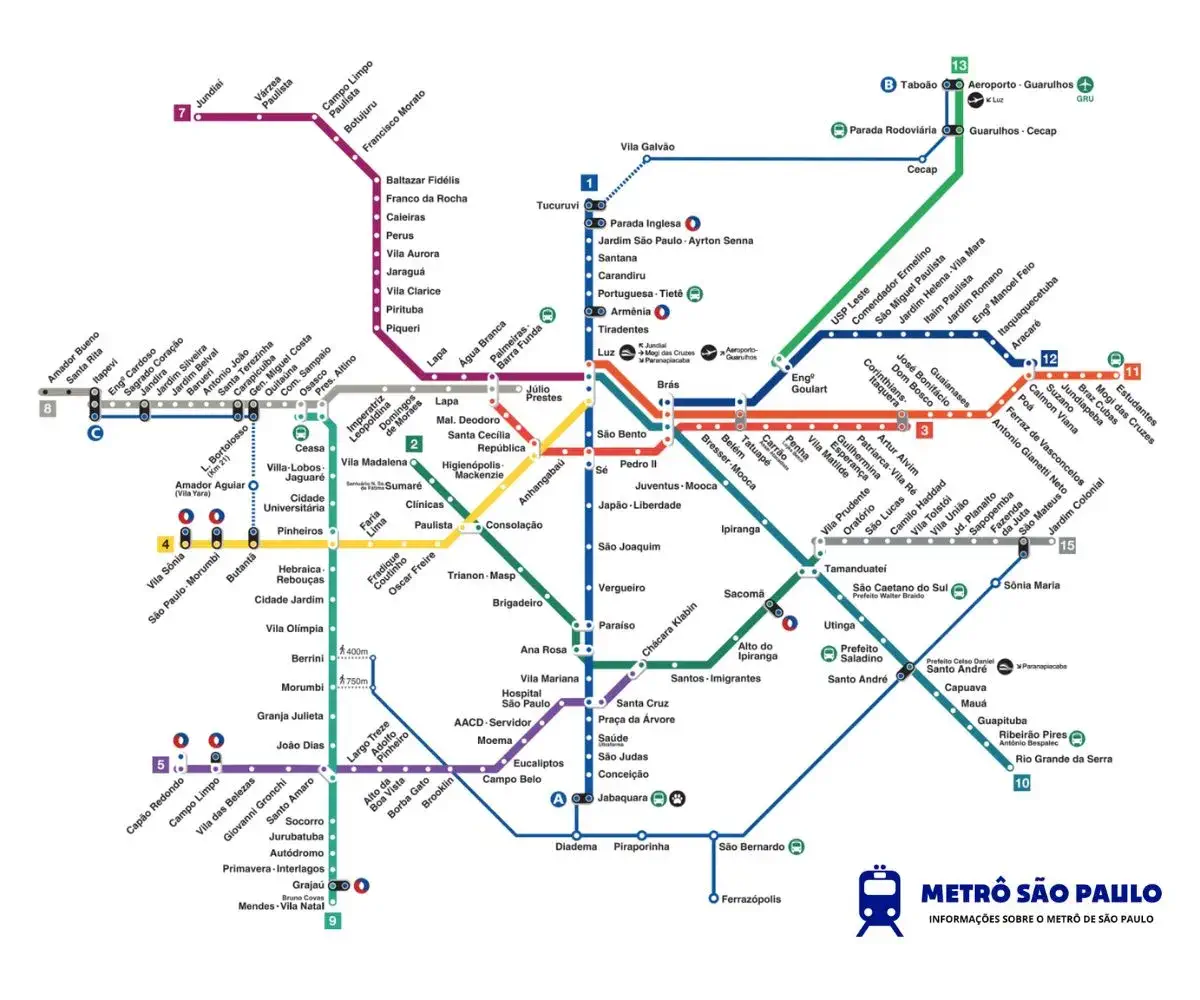
If you wish to download the map for printing, you can do so by clicking the link provided here.
If you want to know more details about the map and all the lines and stations in the system, click the button below.
São Paulo Metro Stations
The stations of the São Paulo Metro are as follows:
- Tucuruvi
- Parada Inglesa
- Jardim São Paulo – Ayrton Senna
- Santana
- Carandiru
- Portuguesa-Tietê (formerly Tietê)
- Armênia (formerly Ponte Pequena)
- Tiradentes
- Luz
- São Bento
- Sé
- Japão-Liberdade
- São Joaquim
- Vergueiro
- Vila Mariana
- Santa Cruz
- Praça da Árvore
- Saúde
- São Judas
- Conceição
- Jabaquara
- Vila Madalena
- Sumaré
- Clínicas
- Consolação
- Trianon-MASP
- Brigadeiro
- Paraíso
- Ana Rosa
- Chácara Klabin
- Santos-Imigrantes
- Alto do Ipiranga
- Sacomã
- Tamanduateí
- Vila Prudente
- Palmeiras-Barra Funda
- Marechal Deodoro
- Santa Cecília
- República
- Anhangabaú
- Pedro II
- Brás
- Bresser-Mooca
- Belém
- Tatuapé
- Carrão
- Penha
- Vila Matilde
- Guilhermina-Esperança
- Patriarca
- Artur Alvim
- Corinthians-Itaquera
- Vila Sônia
- São Paulo – Morumbi
- Butantã
- Pinheiros
- Faria Lima
- Fradique Coutinho
- Oscar Freire
- Paulista
- Higienópolis-Mackenzie
- República
- Capão Redondo
- Campo Limpo
- Vila das Belezas
- Giovanni Gronchi
- Santo Amaro
- Largo Treze
- Adolfo Pinheiro
- Alto da Boa Vista
- Borba Gato
- Brooklin
- Campo Belo
- Eucaliptos
- Moema
- AACD-Servidor
- Hospital São Paulo
- Santa Cruz
- Chácara Klabin
- Oratório
- São Lucas
- Camilo Haddad
- Vila Tolstói
- Vila União
- Jd. Planalto
- Sapopemba
- Fazenda da Juta
- São Mateus
- João Paulo I
- Freguesia do Ó
- Santa Marina
- Água Branca
- SESC-Pompeia
- Perdizes
- Morumbi
- Chucri Zaidan
- Vila Cordeiro
- Vereador José Diniz
- Brooklin Paulista
- Aeroporto de Congonhas
- Washington Luís
São Paulo Metro Route
The São Paulo Metro opened on 14 September 1974 and today is part of a rail network with metro, monorail and commuter rail lines run by several companies.
The metro and monorail lines in service are: Line 1 (Blue) (Jabaquara – Tucuruvi), Line 2 (Green) (Vila Prudente – Vila Madalena), Line 3 (Red) (Corinthians-Itaquera – Palmeiras-Barra Funda), Line 4 (Yellow) (Luz – Vila Sônia), Line 5 (Lilac) (Capão Redondo – Chácara Klabin), Line 6 (Orange) (João Paulo I – Perdizes, since July 2026), Line 15 (Silver) (Vila Prudente – Jardim Colonial) and Line 17 (Gold) (Morumbi – Congonhas Airport, since March 2026).
The Companhia do Metropolitano runs Lines 1, 2, 3 and 15 (and, provisionally, Line 17); Line 4 is run by ViaQuatro, Lines 5, 8 and 9 by ViaMobilidade, Line 6 by LinhaUni and Line 7 by TIC Trens. CPTM runs Lines 10, 11, 12 and 13. Together they form a single network integrated by the Bilhete Único.
São Paulo Metro timetable
If you want to know the São Paulo Metro timetable, I invite you to click the button below to access more detailed information:
São Paulo metro ticket
The São Paulo Metro offers a range of ticket options for passengers. Since 6 January 2026, a single fare on the Metrô and the commuter trains costs R$ 5.40, and a Bilhete Único transfer to city buses costs R$ 9.38. There are also time-based passes and free travel for specific groups; see the Bilhete Único page for details.
Connections between the Metro and buses
The São Paulo Metro allows transfers with buses, making it easier for passengers to get around. You can use your metro ticket to board municipal and intercity buses, providing a practical and convenient option for passengers who need to combine different modes of transport on their journey.
You can also check your Bilhete Único balance with the tool available in the button below:
Customer Contact Channels
- Security SMS
- Information Centre
If you need more information about the São Paulo Metro, you can also get in touch directly with customer service via the phone number provided. By calling this number, you’ll reach a dedicated team who can give you up-to-date information about operating hours, transfers between lines and any other query relating to the metro.
We remind you that it is always important to check the information on the official channels, as the timetables may occasionally change due to events or scheduled maintenance.
Technical specifications
We have compiled some of the most important features of the São Paulo Metro so that you can get to know them.
- Operators: Metrô, ViaQuatro, ViaMobilidade, LinhaUni (metro and monorail)
- 24-hour service: only on Saturday-to-Sunday nights on Lines 1, 2, 3 and 15 (trial until 31/01/2027)
Information about the São Paulo metro
We have compiled and answered a series of questions that passengers, or anyone interested in learning more about the SP metro, may have. The information has been cross-checked in order to provide accurate answers to the following questions.
How many lines does the São Paulo metro have and what are their colours?
As of October 2026, the São Paulo metro has 8 lines in service, each identified by a colour and a number: Line 1 (Blue), Line 2 (Green), Line 3 (Red), Line 4 (Yellow), Line 5 (Lilac), Line 6 (Orange, opened in July 2026), Line 15 (Silver) and Line 17 (Gold, a monorail opened in March 2026). The rail network also includes commuter rail Lines 7 to 13.
How can I pay for my journey on the São Paulo metro?
You can pay for your metro journey using public transport cards, such as the “Bilhete Único” card. This card is topped up with credit and is used to travel on the metro and other public transport in the city.
What are the metro's operating hours?
Operating hours vary by line and station, but in general the metro runs from 4:40 to 0:00; on Saturday-to-Sunday nights Lines 1, 2, 3 and 15 run all night as a trial (until 31 January 2027). Lines 6 and 17 still have reduced hours. You can check the specific timetable on the “Timetable” page.
How can I transfer between different metro lines?
At many stations, there are transfer corridors and tunnels that connect different metro lines. You can follow the signs indicating the connections and the line names to make your transfers.
Is the São Paulo Metro accessible for people with reduced mobility?
Yes, the São Paulo metro has been working to improve accessibility for people with reduced mobility. Many stations have lifts and ramps; check each station’s accessibility with the line operator.
Does the São Paulo Metro offer discounts for students or the elderly?
Yes, there are special fares for students and senior citizens. A specific card is required to access these discounts. You can get more information at the stations or on the official metro website.
History and opening of the São Paulo Metro
The São Paulo metro system has a history of several decades of growth to meet the transport needs of one of Brazil’s largest cities. Here is a summary:
In 1968 the Companhia do Metropolitano de São Paulo (CMSP), a state-owned company, was set up to plan and build the system.
In 1974 the first section of Line 1 (Blue) opened, between Jabaquara and Vila Mariana. The line reached Santana in 1975 and Tucuruvi in 1998.
Line 3 (Red, East-West) opened in 1979, between Sé and Brás, and reached Corinthians-Itaquera in 1988.
Line 2 (Green) opened in 1991, between Paraíso and Consolação; today it runs from Vila Madalena to Vila Prudente.
Later came Line 5 (Lilac, 2002), Line 4 (Yellow, 2010), the Line 15 (Silver) monorail (2014) and, in 2026, the Line 17 (Gold) monorail (March) and Line 6 (Orange, July).
Rules for using the São Paulo metro
Inside the facilities and when using the metro’s services, it is essential to obey a series of rules and regulations that must be respected. Below are the guidelines to follow:
- Before boarding the train, people should be allowed to get off first. The rule is: let passengers off before you get on.
- It is passengers’ responsibility to obey the rules and follow the instructions given by Metro staff.
- When the door-closing signal sounds, for safety reasons you are not allowed to enter or leave the train.
- Do not cross the platform safety line until the train has come to a complete stop.
- It is important to respect other passengers and avoid causing a nuisance during the journey.
- Remember that smoking is prohibited in the train carriages and on Metro premises.
- The alarm devices in the carriages should only be used in justified situations.
- With the exception of guide dogs, animals are not allowed on the metro.
- Try to avoid carrying bulky or dangerous objects on the train to ensure the comfort and safety of all passengers.
- Access to the train driver’s cabs is not permitted.